B4FIAR: Jesse Bear and {Learn & Play Link Up}

Wednesday, 11 November 2015

I am starting Before Five in a Row with Vito.  I am a fan of FIAR and I’ve been doing it with Mavi for years. 

Last week, we did Jesse Bear, What Will You Wear?  Vito loved it instantly!  He can relate to the daily activities of Jesse Bear and how amazing he recognizes most of it as part of his routines.  Like changing his shirt, high chair and mealtime, bath time and when running towards Daddy when my husband arrives from work. 

Now here are the activities we did to go along with Jesse Bear:

JesseBear

Morning

We played in the yard, put on his jacket and red pants Open-mouthed smile 

DSC_0050

Then try to play sand just like Jesse Bear. That is Kinetic Sand and we are loving it!

DSC_0295

Noon Time

Lunch time, he ate some steamed veggies, then apple and drank milk.  He insisted that we place the book in his table to make sure he’s doing what Jesse Bear is doing.DSC_0627


DSC_0632

Afternoon Time

To kill time we played with colored rice and scooping because Jesse Bear was playing with his rice! 

DSC_0301

We also played matching shoes game!    When your child is about 1.5yrs old, they’re able to discriminate objects. Try matching games as simple as matching their shoes! Vito is such an expert!

DSC_0637

Bedtime

Vito’s bedtime routine includes brushing his teeth (like Jesse Bear), washing his face and putting on his PJs.  I say this out loud as I do it so he’ll understand what we are doing.  And just like what I did with Mavi, I would read him books while I put him to bed.  This actually calms him down…. and make us both sleepy LOL. 

DSC_0229

Follow us on Facebook, Pinterest, Google Plus, Instagram or Twitter for updates!

JesseBearPIN

Welcome to the Learn & Play Link Party!
Here are the featured literature-based activities for this week!
 
LinkyPIN
 
Harry Potter Sorcerer’s Stone Unit from Every Star Is Different
Fall Book Basket for Preschoolers from Homeschool Preschool
Peter Pumpkin Eater Printables from Embark on the Journey
Madeline Sensory Tray Writing from Growing Book By Book
 
11206071_10206383760770609_4191824351964193280_n
Now it’s time for this week’s link party! This is a BRAND new link up for all blog posts that include learn and play activities and hands-on education for kids. We are excited to read your blog posts and to see what you have to share! Please link up below and grab our button to display on your blog.
If you are a blogger, share your family friendly posts here. We are looking for things which include:
  • Montessori Education
  • Homeschool
  • Sensory Play
  • Tot and Preschool Trays
  • Fine and Gross Motor Activities
  • Kids in the Kitchen
  • Healthy Recipes for Kids
  • Arts and Crafts
  • Natural Living
  • Free Educational Printables
  • Family-Oriented Activities
  • Healthy Living
Your post will be featured on each of our blogs where we will pick our favourite posts every other week. That means there is more of a chance that you will be featured!
Everyone, please meet our link party hosts:
learn and play party hostesses
Christian Montessori Blog ~ Please visit our CMN FB group ~ Pinterest

GUIDELINES FOR LINKING

  • Please link up 1-3 posts
  • Follow each of the hosts on social media
  • When you link up, please add our button and place it at the bottom of your shared posts or link back with text link.
  • By entering a link, you’re giving us permission to feature an image on our blogs. Proper credit & links will ALWAYS be given.
  • Please visit a couple of shared posts and leave a comment for them
  • Remember that you must link back in order to be featured
Grab This Button:
Christian Montessori Network
<div align="center"><a href="http://christianmontessorinetwork.com/category/learn-and-play" title="Christian Montessori Network"><img src="http://www.christianmontessorinetwork.com/wp-content/uploads/2015/04/learn-and-play-link-up-150-150.png" alt="Christian Montessori Network" style="border:none;" /></a></div>

Please Follow
Follow Pinay Homeschooler's board Pinay Homeschooler on Pinterest.

How to Teach a Toddler About Trees

Monday, 9 November 2015

During the midterm break I’ve been taking the boys out because of the glorious weather.    And since whenever we’re out, Mavi would climb the trees (and Vito would do the same), I took the chance to formally introduce Vito to trees.  Since he’s able to say words straight and could grasp simple concept, it’s about time I show him the wonders of trees!

DSC_0965

The BEST way to learn about trees is to have a personal encounter with it.  And since we’re surround by them, we explored trees’ by climbing, touching and feeling their barks, observing the leaves colors, compare sizes and more. 

DSC_0011

DSC_0029

DSC_0909

For Vito though, trees are something that he can climb on.  Whenever he sees a tree, he would just insist to climb onto it, like the picture below.  He was just in that position for about 30 minutes, not complaining and enjoying every single moment of it.


xxxxx (1 of 1)-31

With these, I can conclude that Vito can somehow understand now that trees :

  • have leaves
  • have rough barks
  • comes in big and small sizes
  • are something we can play with

Now, for extensions,  I also prepared simple tree-themed activities for Vito at home for indoor play and learning.  Here are the trays I prepared for him:

xxxxx (1 of 1)-8

Counting Trees.  Vito loves this! I stamped four dots in the paper with a number symbol and we count as we place a tree on each dot.  I used a do-a-dot marker for this.

DSC_0073

xxxxx (1 of 1)-9

Matching Trees (Abstract-Abstract).  Remember when we worked on leaves and he’s not interested in matching cards at all?  Well, that changed now as he was able to work on our matching tree cards without hesitation!  And yes he completed the four pairs with much concentration. I love it!  You can get these beautiful cards from here or click the image below.

xxxxx (1 of 1)-17

xxxxx (1 of 1)-10

Tree Puzzle.  He loves working on tree puzzle but somehow, our tree puzzle is still too complicated for his age.  He knows where to place the roots and trunk as of the moment, but finds it hard to fit them in the puzzle board.  So what I do is just ask him where the piece is supposed to go, he points and I do the fitting.

DSC_0180

Tree Matching.  Similar matching activity as above, but in this case we are using a tree figure and matching it to cards.  We are doing lots of matching activities as this introduces early math concepts and object discrimination.  Tree figures are from Safari Toobs.

xxxxx (1 of 1)-19

Books.  These are the books that we focused on during the week of our tree themed activities: Chicka Chicka Boom Boom and The Acorn’s Story, both of which are so enjoyable to read!

DSC_0294

And how long do we have this for a theme? Mostly for 7-10 days!  Of course, these are just some of the thing he does, he also plays with his toy and read book, learn letters and numbers.  It’s just that I love introducing new concept/s each week and in a way its easier for me to focus on just one or two things.

Follow us on Facebook, Pinterest, Google Plus, Instagram or Twitter for updates!

Don’t forget to PIN this for later!

letter t trees

History of Ancient Europe

Sunday, 8 November 2015

If you’ve been following us in Instagram, you should all by now know that Mavi is obsessed with world history.  It all started with his fascination with Horrible Histories and then he started to borrow books from the library.  That’s why I purchased the Story of the World books to feed his interest.  We’ve been reading it for awhile and almost done with Story of the World Book 1: Ancient History.

I wanted to share with you how we study world history at home.  Aside from our previous lessons of Ancient Egypt, Mavi wanted to learn about the history of Europe.  So this is where we are focusing as of the moment.  These cards are included in my Europe in a Nutshell file.

HistoryAncientEurope

I just added the description cards for personal use, whenever we wanted to review the details.

xxxxx (1 of 1)-2

The cards are currently displayed on top of my shelf so Mavi can work on them anytime.  This is the best way to learn the time periods as well, like what’s BC and AD Open-mouthed smile

xxxxx (1 of 1)-4

After I introduced him to the time periods, he arranged the cards by himself.  He was confused with the BC and AD at first but he later on grasp the concept.

xxxxx (1 of 1)-3

xxxxx (1 of 1)-5

Now, pictures and fact cards aren’t enough, we’ve got to locate these in the map!  Here Mavi is seen locating Crete, where Europe civilization started.  An understanding of  geography and location will make the child understand the history and culture of the ancient people.  We also located the Mediterranean Sea, the gateway of ancient Asians who entered Europe and where most of the battles occurred.  The map is from the activity book of the STOW Book 1 printable version.

xxxxx (1 of 1)-7

As I mentioned earlier, we are reading STOW Book 1 to go along with the cards but doesn’t entirely equate to the details I put in out Ancient Europe Timeline cards.

Follow us on Facebook, Pinterest, Google Plus, Instagram or Twitter for updates!

And you might as well PIN this post for future reference.

HistoryAncientEuropePIN

Hands-on Learning on European Regions

Thursday, 5 November 2015

Mavi is into geography once again and we are revisiting Europe.  My approach for this year’s study is to look at Europe through the different regions.  It’s easier to understand and internalize facts when they’re into smaller groups than attacking it as a whole.

So I created these label cards for northern (blue), western (red), southern (orange) and eastern (green) Europe.  The color coding is based on our map in Europe in a Nutshell.  The mini flags seen in the photo is from Flags of Europe printable.

RegionsEuropeFB

He easily identified Greece, Italy and Spain as southern Europe.

DSC_0553

Our Montessori Europe Puzzle Map is from Absorbent Minds UK.


DSC_0556

After he sorted some of the countries, he proceed on completing  the puzzle map on his own.  I provided a control map from Montessori Print Shop.

DSC_0592

I love that he removed the puzzle pieces and placed them on a basket instead of scattering them in the rug.

DSC_0581

More updates on the Europe Continent in the next coming days so stay tuned!

Follow us on Facebook, Pinterest, Google Plus, Instagram or Twitter for updates!

And you might as well PIN this post for future reference

RegionofEuropePIN

Simple Experiments: Twinkle Twinkle Stars and {Learn & Play Link Up}

Wednesday, 4 November 2015

I love simple and easy to prepare experiments.  That’s why when we received a Janice VanCleave’s book as present last year, I was so elated! I love her books of experiments!  So we are trying some of it and so far the boys are enjoying it!TwinkleStars

Objective:  To simulate the twinkling of stars in sky.

Materials needed:

  • a large square foil
  • glass bowl (preferably 2 liters)
  • tap water
  • a torch/flashlight

    pencil


    DSC_1001

    Procedure:

    1.  Crumple your square foil and place it on a table or on a floor.

    2.  Fill your clear bowl with tap water and place it on top of the crumpled foil. 

    DSC_0022

    3.  Darken the room by turning off the lights.  Hold the torch or flashlight above the bowl.  Distance from the bowl  is about 12 inches.

    4.  Observe the foil through the undisturbed water.

    DSC_0036

    5.  Now using your pencil, tap the surface of the water gently.  Observe the foil through the moving water.

    DSC_0052

    DSC_0068

    What happened? 

    The light rays reflecting from the foil when there was a movement in water appears to blur or twinkle. 

    Why? 

    The movement of the water causes the depth of the water to vary.  The light rays twinkle because they bend or refract in different direction when it passed through the different depths of water. 

    This is similar to the light rays of the stars.  They appear to be twinkling when you are observing from earth because they refract differently as the light rays move through the different thickness of air in the atmosphere.  Scientifically, this twinkling phenomenon is called ‘scintillation’. 

    Follow us on Facebook, Pinterest, Google Plus, Instagram or Twitter for updates!

    And you might as well PIN this post for future reference.

    STARSPIN

    Source:  Janice VanCleave Astronomy

    Welcome to the Learn & Play Link Party!

    In relation to our activity this week, I am featuring space and astronomy themed activities!

    SpaceLinkUp
     
    The Earth, The Sun & Stars from Every Star is Different
    Space Explorer Toolbox from Montessori By Mom
    Sensory Play for Earth Day from Mama’s Happy Hive
    Earth Day from Child Led Life
    11206071_10206383760770609_4191824351964193280_n
    Now it’s time for this week’s link party! This is a BRAND new link up for all blog posts that include learn and play activities and hands-on education for kids. We are excited to read your blog posts and to see what you have to share! Please link up below and grab our button to display on your blog.
    If you are a blogger, share your family friendly posts here. We are looking for things which include:
    • Montessori Education
    • Homeschool
    • Sensory Play
    • Tot and Preschool Trays
    • Fine and Gross Motor Activities
    • Kids in the Kitchen
    • Healthy Recipes for Kids
    • Arts and Crafts
    • Natural Living
    • Free Educational Printables
    • Family-Oriented Activities
    • Healthy Living
    Your post will be featured on each of our blogs where we will pick our favourite posts every other week. That means there is more of a chance that you will be featured!
    Everyone, please meet our link party hosts:
    learn and play party hostesses
    Christian Montessori Blog ~ Please visit our CMN FB group ~ Pinterest

    GUIDELINES FOR LINKING

    • Please link up 1-3 posts
    • Follow each of the hosts on social media
    • When you link up, please add our button and place it at the bottom of your shared posts or link back with text link.
    • By entering a link, you’re giving us permission to feature an image on our blogs. Proper credit & links will ALWAYS be given.
    • Please visit a couple of shared posts and leave a comment for them
    • Remember that you must link back in order to be featured
    Grab This Button:
    Christian Montessori Network
    <div align="center"><a href="http://christianmontessorinetwork.com/category/learn-and-play" title="Christian Montessori Network"><img src="http://www.christianmontessorinetwork.com/wp-content/uploads/2015/04/learn-and-play-link-up-150-150.png" alt="Christian Montessori Network" style="border:none;" /></a></div>

    Please Follow
    Follow Pinay Homeschooler's board Pinay Homeschooler on Pinterest.

  • Learning about Reptiles: Snakes

    Monday, 2 November 2015

    Snakes

    If you are in the UK or Ireland, you must have heard of Steve Backshall and his animal shows like the Deadly 60.  Mavi is obsessed with Steve, due to his witty and pleasant hosting of the show. You can learn about it here.  Now, going back, he’s been featuring reptiles lately, mostly how dinosaurs evolved into crocodiles, birds,  snakes etc. 

    What are Reptiles?  We learned from our previous study of the Vertebrate animals that REPTILES have a covering of bony plates or scales.  They vary in sizes and shapes and include forms like snakes, alligators, crocodiles, turtles and lizards.  Reptiles make their homes in great variety of places .

    In this post, I will be focusing on snakes, as Mavi and I had a brief discussion about them a few days ago.  This is the book we’ve got of Steve Backshall and we used it as a reference.  We had a few snake figures from Safari Ltd Reptiles TOOB .

    DSC_0987

    Books.  These are the books of Steve Backshall we borrowed from the library.  Youcan check them out here:Steve Backshall's Deadly 60  

    DSC_0988

    Characteristics of Snakes (things we learned):

  • Snakes’ coverings are dry with perfectly dry scales, they are not slimy.
  • A snake’s tongue is a sense organ, just like an insect’s antennae.  Therefore, when a snake thrusts its tongue, it is simply trying to find out about its surroundings and what is going on.
  • They are the only creatures that can swallow objects larger than themselves.  This is because they have elastic body walls.
  • Snakes have an extra bone hinging the upper to the lower jaw, which allows them to spread widely when swallowing an object.
  • The noiseless and graceful movement of the snake is brought about by the crosswise plates of the snake’s body that is connected to the ends of its ribs.

    Life Cycle of a Snake

    This life cycle material is for FREE and you can download it from my SCIENCE PRINTABLE PAGE.

    So we looked into the process of how snakes give birth.  We also learned that NOT ALL SNAKES GIVE BIRTH BY PRODUCING EGGS. ANACONDAs give birth to their young!

    Snakes Around the World

    So I gathered a list of snakes and we looked at them over the internet.  I didn’t produce any printable file as the images are all copyrighted.  But I provided the link below on where you can find them, and see how they look like or learn about their habitats.

    • Ribbon Snake [wiki]
    • Coral Snake [wiki]
    • Rubber Boa  [link]
    • Rough Green Snake  [link]
    • Timber Rattler  [link]
    • Desert Gopher Snake [link]
    • Ring Necked Snake [link]
    • Sidewinder or Horned Rattlesnake  [link]
    • Pike Headed Tree Snake  [link]
    • Pilot Black Snake [link]
    • Copperhead Snake [link]
    • Southern Hognose Snake [link]
    • California Lyre Snake [link]
    • Water Moccasin [link]
    • Gray Pilot Snake [link]

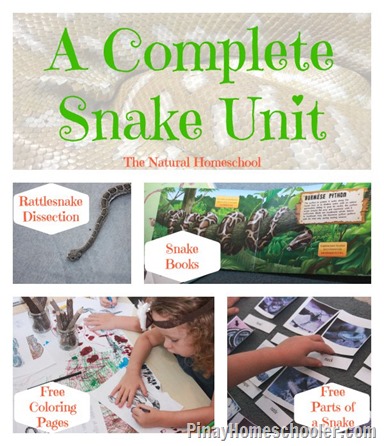
    You might also be interested in these amazing Snake Units:

    snake-main

    Montessori-Inspired-Snake-Unit-www.mamashappyhive.com_