Showing posts with label shop. Show all posts

Having Fun with London Playsets & Cards

Friday, 26 February 2016

*** contains affiliate links ***

LondFB

We are all in love with our wooden London Playset/s which we acquired recently.  It’s so precious and beautiful that I can’t seem to take it out the bag!  

Now how do we use these figures?

As LEGO would say it, “imagination is the limit!”, we use these wooden materials in so many ways!  We use it for imaginative play, setting up the London city with trains and cars and use our Playmobil figures to play pretend as tourists.

And to enhance its educational value,   I created a picture booklet with cards so we can learn more about the story behind the icons.  Another playset we’re using is the Playmobil where we’re using the Queen as an additional  character in our set.  The picture book that we have has this beautiful clip arts of United Kingdom’s landmarks (including Scotland and Wales).  Mavi reads the picture book as he identifies the figure. 

pinayhomeschooler (1 of 1)-22

Vito is the one who mostly uses the cards (Mavi uses the outline pages for colouring) as he loves identifying and matching things.

pinayhomeschooler (1 of 1)-21

Now a little bit of the London playset, the Big Ben and London Bridge are stackable, and is made up of little pieces.  It doesn’t bother me though. Mavi suggests we glue them but I don’t really want to do that.  The London Eye is impressive, Vito loves to spin it!  DSC_0514

Of course, it wouldn’t be London without those iconic “red” buses, guards, postal kiosk  and  telephone box.

DSC_0524

I am so pleased with this toy, and when not in use as a toy, you can display it in your shelf to add colours to your sitting room.  I couldn’t recommend this enough!

If you are interested in our United Kingdom Picture Book (which includes the cards as well), click here or the image below to purchase.  It’s absolutely worth-it!

uk copy

Follow us on Facebook, Pinterest, Google Plus, Instagram or Twitter for updates!  More learning materials at Pinay Homeschooler Shop.

Pin this for later!

London

Learning the Parts of the Human Eye

Saturday, 20 February 2016

** contains affiliate links **

HumanEye

It’s Mavi’s midterm break and we decided to look into the parts of the human eye!  We examined our model unit this morning which we bought last year from the local store.  It’s so perfect and goes along so well with our Human Eye Nomenclature Cards and Booklet. 

The Human Eye

To start with, we disassemble our eye model and identify the parts using our nomenclature cards.   Mavi was surprised that his eye is actually shaped like a sphere and yes, a ball!  All the while he thought it was flat. So as we identify the parts using the model, he can’t stop himself from examining my eye as well LOL.

DSC_0430

When the parts were completely taken apart, we read our booklet to know the purpose of each part.  Don’t you just love our eye model? Even the inside of the eyeball has drawings of blood vessels on it. So detailed! 

DSC_0433

I’m so used of making these booklets that I was able assemble it in just a few minutes.  I laminated the pages as well for longevity.

DSC_0436These are the 3 part cards.  I decided to add the eyelid and eyelash in the parts as they are also essential in defining the human eye.

pinayhomeschooler (1 of 1)-18

Our little man was also as excited and thrilled to examine the human eye.  He was observing his brother and was attentively listening to Mavi’s soliloquy LOL.

                                     DSC_0448DSC_0446

And finally! He got the chance to borrow the eyeball and started to emulate his brother.

DSC_0456

For the eye model/s here are the links where you can get them:

UK/Ireland

US

Follow us on Facebook, Pinterest, Google Plus, Instagram or Twitter for updates!  More learning materials at Pinay Homeschooler Shop.

Pin this for later!

HumanEyePIN

Australia/Oceania in a Nutshell

Monday, 4 January 2016

Finally, my Australia in a Nutshell is finally up!  It took me awhile to complete this set because of the holiday season.  I’ve been receiving a lot of requests from readers to publish this set but I’ve been too preoccupied for the past weeks. 

Australia in a Nutshell copy

Buy now

I am currently printing and laminating this for our Australia Unit just in time for Australia day in January 26. 

So here are the contents of the file:

1.  Maps.  I included two maps in this file: [1] map of Australia and [2] map of Oceania.

Picture1e

2. 3 Part Cards of the Australian States.

Picture2e

3.  Country Fact Cards of Australia and Oceania.  There are 27 fact cards provided to learn about the climate, currency, government, etc of the countries that composes Oceania.

Picture3e

4. Fact Cards.  Everything you needed to know about Australia and other countries in Oceania is provided in these 56 fact cards. Mavi loves to read this and learn about the people and their culture in different continents.  I bet your kids will love this too! 

Picture4e

5.  Platypus and Frilled Lizard Nomenclature Cards. I always include these in my Nutshell series as they are my kids favourite (when Mavi was younger).  Kids love to learn about animals especially those that only thrives in a specific continent/country.

Picture6ePicture5e


Follow us on Facebook, Pinterest, Google Plus, Instagram or Twitter for updates!

Other Nutshell files available:

                               africa nutshell presentation     asia cover copysm

                              south america cover copysm       Europe In A Nutshell_small

History Timeline Cards: Ancient Times

Sunday, 29 November 2015

Anicent History Timeline Cards copy

Buy now

Up in the Sellfy Shop is our history timeline cards Ancient Times.  The file includes the following:

  • 40 timeline cards of the ancient times (occurred between the period of 5000BC to 500BC). The timeline cards has
  • 40 definition cards for each timeline card
  • 3 pages of timeline sheets that can be connected to form as a guide. The pages are in A4 paper size.

Learn how we used it here and in how we study the European History.

Hope you like it, enjoy!

Follow us on Facebook, Pinterest, Google Plus, Instagram or Twitter for updates!

Learning the Timeline of European History

Monday, 16 November 2015

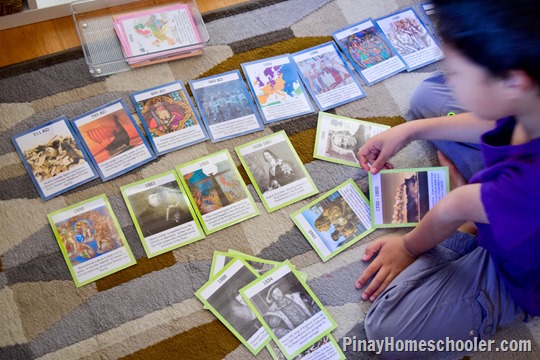
I am so excited to share with you our approach on learning the timeline of the European history.  As I mentioned earlier, my son is obsessed with world history, especially with the events in Europe and Asia (his home continents!) so while he is at it, I grabbed the opportunity to discuss the great history of Europe.  To achieve this, I created these beautiful  timeline cards which contains bold pictures (because kids are attracted to pictures) and included a brief description for each of the event.  I thoroughly researched this, and handpicked the major events to be included in the cards. We were always reading the books of the Story of the World series, but most of the events in the cards were not included in the book.

xxxxx (1 of 1)-41
Our timeline cards covers the 4 periods in history:  ancient times, medieval times, early modern times and modern times. 
Goals
  • In each period, we will identify the fundamental needs of man:  Spiritual (love, religion, culture/community) and Material (shelter, transportation, food and clothing)
  • Identify the locations in the map where the event occurred
  • Historical figures that played a major role in that historical period
  • Be able to arrange the timeline cards
  • Compare the impact of each period to Mavi
Ancient Times (up to 500AD)
My Ancient Time Cards starts from the event occurred in Mycenae to the end of Byzantine Empire.  We talked about how Greece played a major role in the beginning of the European history, great conquerors like Alexander the Great, the rise and fall of Rome. It was obvious that aside from the material things, religion played a major role in the development of the European culture.  
xxxxx (1 of 1)-11
Modern Times (500AD to 1500)
Major events include the wars in Europe after the fall of Rome, the Black Death, the crusades, the significance of the Vikings in forming what is now known as the Great Britain, Constantine and Charlemagne, the separation of Orthodox and Roman Christians.  
xxxxx (1 of 1)-12
Early Modern Times (1500-1900)
The Early Modern Times is all about Renaissance, and because of Industrial Revolution, people started to explore places. Inventions of steam train, and ships.  But there were also civil wars like in France and between England and Scotland.  Mavi and I identified the causes of these wars and yes it’s all because of the fundamental human needs.
xxxxx (1 of 1)-13
Modern Times (1900 – present)
Modern Times was quite challenging because Mavi asked a lot of questions in this period.  Most especially in the events of World War I and II, and the wars in the Baltic.  There are just certain things that you can’t explain to a 7 year old.   So I just told him stories of what I know (I have yet to purchase the Vol 4 of the Story of the World) and what I read in the web.
xxxxx (1 of 1)-14
Using the Cards
Our aim is to arrange the cards according to the time of events.  We set up a few craft strings in our shelf where we can pin the cards.  This is an amazing technique for visualization of the entire events!
xxxxx (1 of 1)-24
Seen below, Mavi is reviewing his work, making sure he’s arranging the time in order.  I previously taught him how the BC and AD works, so this is a perfect opportunity to put that knowledge into action!
xxxxx (1 of 1)-23
He loves the cards and enjoys reading the description.   I wanted the cards to be as attractive and engaging to Mavi so I made sure that I don’t put too much facts into the description.     Because of this, I created another set of cards for the “longer” description .xxxxx (1 of 1)-25
xxxxx (1 of 1)-3
He was proud of his work and asked to take a photo of him with his work LOL.
xxxxx (1 of 1)-27
So this is how I explained and presented the history of Europe to my 7 year old boy . 
Follow us on Facebook, Pinterest, Google Plus, Instagram or Twitter for updates!
And you might as well PIN this post for future reference.
xxxxx (1 of 1)-42
This post is part of the 12 Months of Montessori Learning which is hosted by Natural Beach Living and The Natural Homeschool.
10330283_646648502125072_8924215594889189894_n
Linear Calendar for Kids by Planting Peas
Montessori Calendar for Kids by Mama’s Happy Hive
How to Introduce Time to Kids by Study at Home Mama
Our Montessori-inspired Timeline of Life by Every Star is Different


Now for the AMAZING GIVEAWAY!!
My friends and I in the 12 Months of Montessori Series are having a giveaway!  Join and have the chance to win $150 gift certificate to Montessori Services plus Montessori by Mom Art Toolbox!  This giveaway is open to all  US and Canadian readers only. 
576321ef-686b-464f-839a-e5a607d4fd20

Pre-K Problem Solving Cards

Saturday, 31 October 2015

Mavi didn’t like math.  When he was around 5yrs old, he would rather read books than work with math.  He’s excuse would always be “I’m tired” or “it’s difficult”.  I can truly understand him though. I didn’t enjoy math when I was younger.  Until I stepped into secondary school and discovered why we need math.

So instead of forcing him to solve arithmetic problems and giving him number activities, I exposed him to real life problems so he can appreciate math.  I made him understand WHY WE NEED TO LEARN NUMBERS AND MATH.  We would go to the groceries and count our items all together, doing addition and subtraction in between.  Of course, he’s not aware we’re doing math, all he knows is that he’s helping Mommy do some groceries.  At home, I secretly incorporate addition and subtraction by counting his missing pens, his toys and how many books he has read.

He loves the real life math! He can’t stand arithmetic problems but he enjoys real life problems.  So what I did was create a bunch of colorful cards for us to work on, making sure there’s pictures (and we mostly use counters as well) to make it attractive.  In the problems, I used his friends’ name so he’ll like it, and of course he finds it funny!  He kept asking for more, more questions as he liked solving the problems.    And that was the game changer.  

DSC_0164

Through these problem solving cards, he was able to appreciate math, and could now understand why he needs to practice arithmetic.  He loves to solve math problems these days  on his own and still loves solving problems. 

So I created these problem solving cards for Pre-K students.  It contains:

  • 1 step problem solving for addition and subtraction
  • 12 unique questions for addition within 10 (with pictures)
  • 12 unique questions for subtraction within 10 (with pictures)
  • 12 fill-in questions for addition to let the parents change the numbers for more practice (for advanced students, based on the questions with pictures).  You can use counters for this.
  • 12 fill-in questions for subtraction to let the parents change the numbers for more practice (for advanced students, based on the questions with pictures).  You can use counters for this.

L0AddSub copy

Buy now

Mavi worked on these cards when he was 5-6yrs old.  Though this is intended for 5-6yrs old children, older or younger kids can still use the cards as a practice material. Hope you like it and find it useful like we do.  Thanks!

Classifying Vertebrate Animals

Tuesday, 20 October 2015

** Contains affiliate links **

I love unplanned activities.  Mavi would always resort to this activity whenever he’s bored on Fridays (swimming lessons were moved on Saturdays).  I like that he can do this activity independently, while learning the important characters of animals that belong in each group.

VertebrateAnimals

I believe that it is important for the child to have a clear and defined idea of the classes of the animal kingdom and its division.  What’s important to me is to have him gain the knowledge with this activity rather than reading and memorizing the difference in books. 

Just by looking at the animal cards or the figures it is obvious that birds differ from fish or that the turtles differ from mammals because only mammals nourished their young by milk through the breast of the mother.

So this is what I usually do, we either work on picture cards as seen above, or work using our basket of animal figures and have Mavi sort them as he describes why that animal belongs to mammals, fish, birds, reptiles or amphibians.  This is a wonderful activity on rainy days or winter!  How fascinating that my son is glued every time he does this.

DSC_0597

Easy to prepare yet fun to perform!

Animal figures used are from Schliech and Safari toob.  The cards are from Vertebrate Sorting Cards file.

Don’t forget to PIN this for future reference!

VertebratePIN

HALLOWEEN and THANKSGIVING Learning Materials

Thursday, 15 October 2015

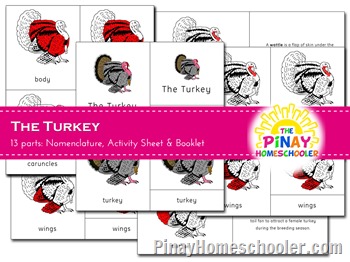
Visit my Sellfy store for some fantastic learning materials this Halloween and Thanksgiving season!  Click on the images below for the download link.

                Owl cards          Spider Cards

               The Bat copy           The Skeletal System copy

                                                   Turkey copy